Design Space : Time
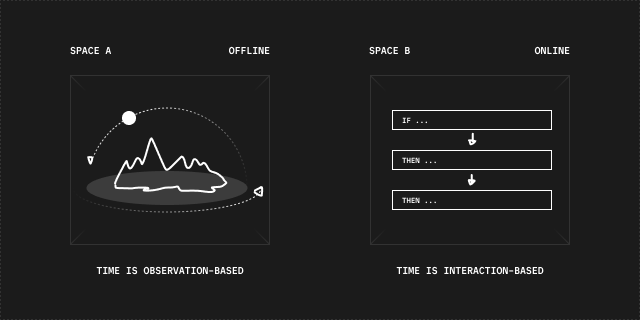
Today we inhabit two spaces. Space A is our offline world, where time is based on natural observation. Sun rises. Seasons change. Planetary movements. Cesium oscillation. Time traditionally is observation-based. Space B is online, where time is an outcome of events constructed. Since the beginning of the connected virtual world time has been a design space. Any multiplayer environment that orders or sequences events creates its own unique clock. Time is plural. Different times coexist. Times can bridge. Time is interaction-based. Alien times can be created.
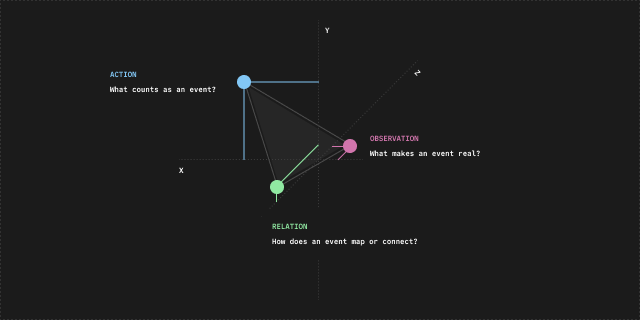
Time, here, is a construct of three coordinates with their own forces. Action: what counts as an event? Observation: what makes an event real? Relation: how does an event map or connect? Together they form a shape. Change any of the three and the shape changes. This feels foreign offline, where natural observed events tend to override the perception of constructed time. Online, each of the three is an addressable, programmable, openly contestable design space.
The design of space and therefore time shapes our concept of lineage, progress, accountability, ownership and essentially identity. It defines what an event is, what a record is, what a turn is, who gets one. It is not a neutral substrate. Most online time today mirrors the tick-based oscillation of natural standardization with a linear forward flow. Blockchains are the primary example, but any multi-actor coordination system or protocol invents, copies, or inherits a concept of time.
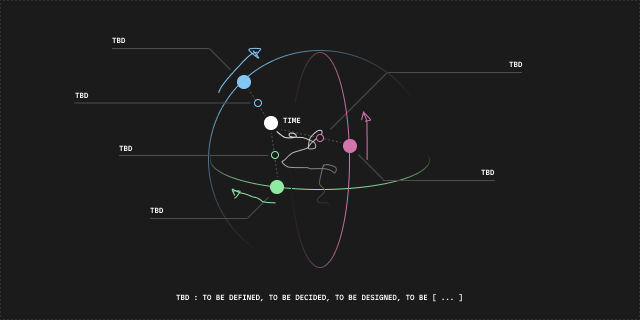
Online, any form of time can already be prototyped. Once prototyped, it can escape the virtual world. This is the opportunity: not a single new clock, but a vocabulary for the plurality of clocks we are already making, mostly without noticing.
Reimagining time is hard because we experience a specific shape of time beyond the screen every day. So the concept proposes two tools. A visualization that lets us see the shape of a configuration of the three bodies and its forces and the different paths time draws. And a WIP card set, an initial vocabulary clustered around the three bodies. We are free to choose any combination of cards to create our own shape of time, name it, and prototype and play test what time it produces.
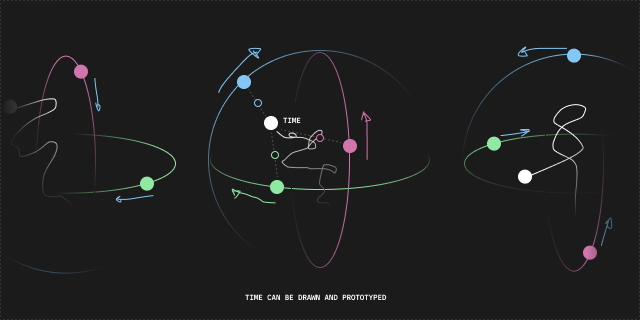
Time has always been a space for play. A plurality of times always coexisted, each defining its own legibility, governance, and longevity. Designing time is a choice. When we can see it [visualization] and play with it [cards] we can shape it. Playing matters now more than ever. We are at the edge of being outpopulated by online-native entities (AI) that do not need to follow our observation-based sense of time. AI is interaction-based by its own design. Time is already alien. We need tools to discover the times we are in, and to choose, together, what times we want to test next. If time is interaction-based, we must interact with it through play.